Engineering a Scalable Resume Processing Pipeline: From EC2 Workers to Event-Driven Serverless Architecture
Large-scale document processing systems rarely fail because of machine learning models.
They fail because of architecture limitations.
When building our resume processing platform, we faced a fundamental challenge:
Recruiters could upload thousands of CVs simultaneously, and the system had to process them quickly while keeping the API responsive.
At the same time, we needed to keep the cost per CV significantly lower than competing solutions.
This article explains the three architecture iterations that allowed us to build a scalable system capable of processing hundreds of thousands of resumes per day.
Problem Context
Typical usage looked like this:
- Daily Active Users (DAU): ~100
- Files per user: 2,500 PDFs
- Potential daily workload: 250,000 CVs
Each document passed through a multi-stage NLP pipeline.
The pipeline included four independent algorithms:
- CV Parser
- JD Parser
- Candidate Matching Engine
- Resume Analyzer
However, these stages were not completely independent.
The pipeline had a strict dependency structure:
CV Parser ↓ JD Parser ↓ Candidate Matching ↓ Resume Analyzer
Candidate matching relied on structured information extracted from the CV parser.
This meant processing could not be fully parallel inside a single document pipeline.
The architecture therefore needed to support parallelism across documents, not within them.
Architecture Evolution
The system evolved through three major stages:
- Distributed Worker Architecture
- Auto-Scaling Cloud Infrastructure
- Event-Driven Serverless Processing
Each iteration solved a different scalability constraint.
End-to-End System Architecture
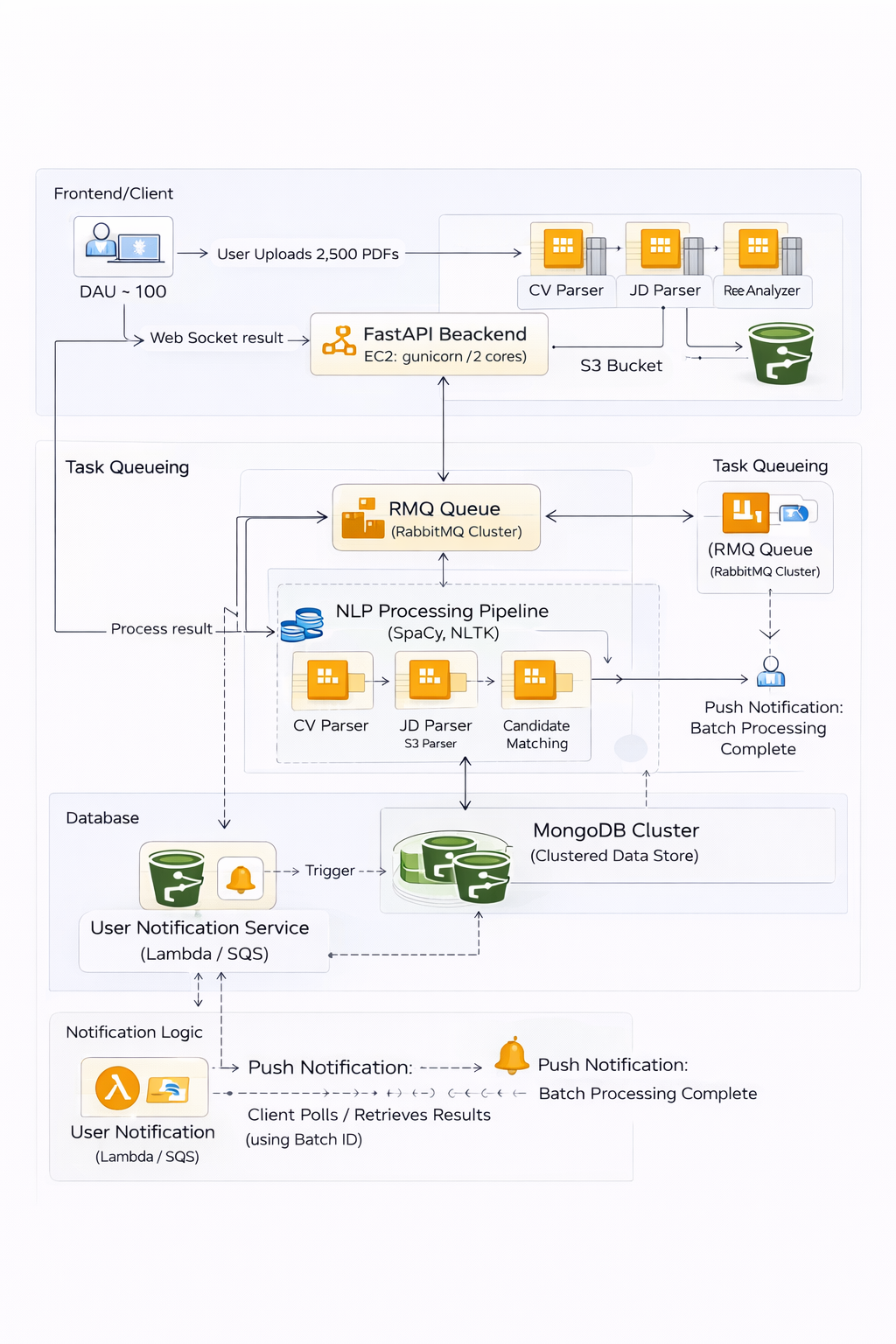
The diagram above represents the core system architecture used for large-scale CV processing.
The system follows a fully asynchronous architecture designed to handle large batch workloads.
Stage 1 — Distributed Worker Architecture
The first version of the system used a queue-driven worker architecture.
API Layer
Users upload large batches of resumes through the frontend.
Typical batch size:
2,500 PDFs
The frontend communicates with a FastAPI backend running on EC2.
The backend used:
- Gunicorn workers
- 2 CPU cores per instance
- asynchronous request handling
Uploads are immediately stored in Amazon S3.
The API returns quickly without waiting for processing.
Task Queueing
Once the files are uploaded, the backend creates processing tasks.
These tasks are pushed into a RabbitMQ cluster (RMQ).
RabbitMQ acts as the central distributed queue for processing jobs.
This allows the API to remain responsive even when thousands of files are uploaded simultaneously.
Distributed Processing Workers
The processing layer consisted of Celery workers running on EC2 instances.
Each worker consumed tasks from RabbitMQ.
Each task executed the NLP pipeline using:
- SpaCy
- NLTK
- rule-based grammar models
Each algorithm ran on a single CPU core, meaning:
1 CV = 1 CPU core execution
Parallelism was achieved by running multiple workers across many machines.
Result Storage
Once the pipeline finished processing a CV, the results were stored in a MongoDB cluster.
The database stored:
- extracted resume fields
- parsed job description features
- matching scores
- candidate analytics
MongoDB was well suited for storing semi-structured NLP outputs.
Stage 2 — Batch Completion Detection
Processing thousands of resumes per batch created another challenge.
Users needed to know when all resumes in their batch had completed processing.
To solve this, we implemented batch completion tracking.
Each upload batch received a unique identifier:
BatchID
Each processed CV updated a counter in the database.
When the final document finished processing, the system triggered a batch completion event.
Stage 3 — Event Driven Notification System
Once the entire batch finished processing, a notification event was triggered.
This event invoked a notification service built with AWS Lambda and SQS.
The notification service performed the following steps:
- Detect batch completion
- Trigger asynchronous notification
- Notify the client application
The user receives a notification that processing is complete.
Result Retrieval
Once the user receives the notification, the frontend retrieves results using the BatchID.
The system supports two mechanisms:
- polling the API
- WebSocket updates
This design ensures the user never waits synchronously for processing.
Throughput
With the architecture above, the system supported workloads such as:
100 users × 2,500 CVs
Which equals:
250,000 resumes per day
Parallel processing across distributed worker nodes enabled large-scale batch processing.
Cost Advantage
One of the most important outcomes of the architecture was cost efficiency.
Typical market pricing for resume parsing systems was approximately:
₹0.75 per CV
Our architecture allowed us to process resumes for approximately:
₹0.10 per CV
This was achieved by:
- CPU-based NLP pipelines
- asynchronous architecture
- efficient queue-based processing
- distributed worker scaling
Engineering Lessons
Several important lessons emerged while building this system.
Asynchronous architectures are essential
Large batch workloads cannot be handled using synchronous APIs.
Queue-based architectures allow the system to scale independently.
Parallelism must be applied carefully
The NLP pipeline had dependencies between stages.
Instead of parallelizing inside the pipeline, we parallelized across documents.
Event-driven systems improve user experience
Users should never wait for long-running processing tasks.
Notification-driven workflows allow systems to remain responsive.
Final Thoughts
In large-scale AI systems, the machine learning model is only one piece of the puzzle.
The real challenge is designing infrastructure that can support:
- massive concurrency
- asynchronous workflows
- cost-efficient scaling
By evolving the system architecture from a simple worker model to an event-driven distributed pipeline, we were able to build a platform capable of processing hundreds of thousands of resumes per day at a fraction of the industry cost.
In production AI systems, *architecture decisions often matter more than the models themselves.